

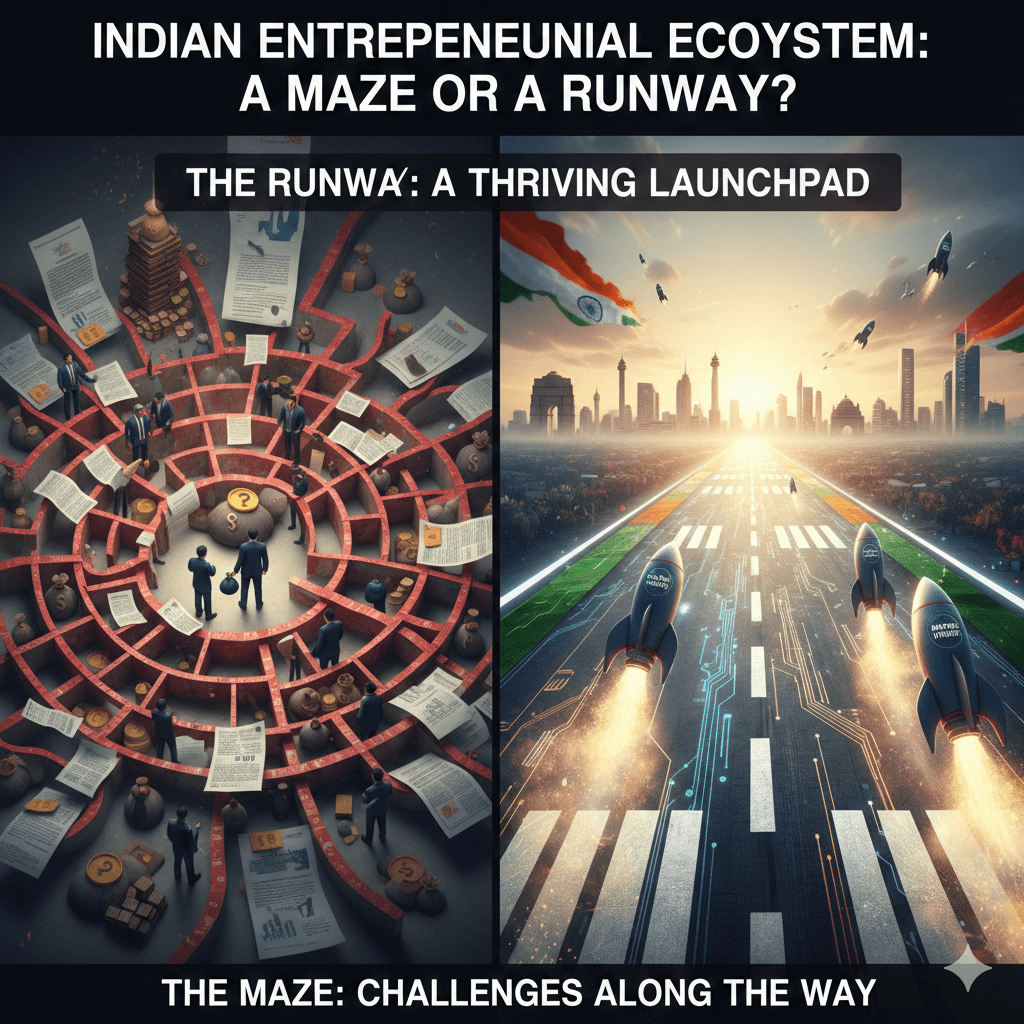
Over the last two decades, India has witnessed a remarkable rise in entrepreneurship. From IT services in the early 2000s to e-commerce, fintech, health-tech, and agri-tech in the 2010s and 2020s, startups have gone from being a niche to becoming mainstream drivers of the economy. Yet, for every success story that makes headlines, there are countless ventures that struggle, pivot, or fade away. This leads to an important question: Is India’s entrepreneurial ecosystem a maze that confuses and traps founders, or a runway that helps them take off?
The answer, as with most complex systems, lies somewhere in between.
The Runway: A Thriving Launchpad for Startups
India has become the third-largest startup ecosystem in the world, with over 100,000 registered startups and more than 100 unicorns (as of 2024). For young founders, the ecosystem provides several “runway-like” advantages:
1. Government Push
Programs like Startup India, Atal Innovation Mission, and Digital India have encouraged entrepreneurship by simplifying incorporation, offering tax breaks, and providing seed funding through incubators. Initiatives such as Fund of Funds for Startups (FFS) channel capital to early-stage ventures.
2. Funding Boom
Global investors view India as a high-growth market. Venture capital firms, private equity, and angel networks are active, with many sectors—fintech, SaaS, climate-tech, and D2C brands—attracting record investments. This has made capital relatively more accessible than it was a decade ago.
3. Talent Pool and Demographics
India’s young population, with millions of engineers and graduates entering the workforce every year, creates a vast pool of entrepreneurial talent. Simultaneously, the rising middle class ensures a growing consumer base for new products and services.
4. Digital Infrastructure
The success of UPI, Aadhaar, and affordable mobile internet has unlocked massive opportunities. A single digital payment framework now supports everything from street vendors to multinational e-commerce platforms. For entrepreneurs, this infrastructure acts as a low-cost runway to scale.
5. Global Recognition
Indian startups are no longer just “copy-paste” models of Western companies. From Byju’s in edtech to Zerodha in fintech, or agritech innovations like DeHaat, Indian startups are shaping global narratives. This global validation strengthens the runway for newer ventures.
The Maze: Challenges Along the Way
Despite the promising runway, many founders feel lost in a maze of barriers, uncertainties, and contradictions.
1. Bureaucracy and Regulations
While reforms exist, compliance in India remains complex. Taxation, GST, labor laws, and foreign exchange regulations often overwhelm young founders who lack resources to manage them.
2. Funding Paradox
Although India has attracted billions in VC funding, most of it flows into a small pool of high-growth startups. Early-stage entrepreneurs outside Tier-1 cities often struggle to raise even small seed rounds. Many investors still hesitate to back “unconventional” ideas, creating a funding maze.
3. Market Fragmentation
India is not one homogeneous market. Regional languages, cultural diversity, and varying income levels mean startups must constantly adapt. What works in Bengaluru may fail in Bihar. This fragmentation complicates scaling, turning expansion into a puzzle.
4. Talent Retention
While India has abundant talent, retaining skilled professionals is difficult. Startups often lose employees to established firms that offer better pay and security. Young ventures in smaller cities feel this crunch even more.
5. Sustainability Pressure
Many Indian startups chase growth at all costs, often burning investor money without achieving profitability. The recent “funding winter” has exposed this weakness, pushing founders into a maze of layoffs, restructuring, and pivots.
Balancing the Maze and the Runway
The Indian entrepreneurial ecosystem is unique because it simultaneously presents both hurdles and opportunities. It is not a smooth runway like in developed economies, nor is it an impenetrable maze. Instead, it is a hybrid—one where founders must learn to navigate the maze before reaching the runway. Successful entrepreneurs often display three qualities that help them thrive in this environment:
Resilience: The ability to face regulatory delays, failed funding pitches, or slow adoption without giving up.
Adaptability: Understanding India’s diversity and customizing products for different audiences.
Resourcefulness: Using frugal innovation to create cost-effective solutions suited to Indian markets.
Conclusion: A Maze That Leads to a Runway
So, is India’s entrepreneurial ecosystem a maze or a runway? The truth is, it is a maze that can lead to a runway. Founders must first navigate the twists and turns of compliance, funding gaps, and market complexity. Those who survive emerge onto a runway where the ecosystem—backed by digital infrastructure, government initiatives, and global interest—can help them take off and scale.
This dual nature is not necessarily a weakness. In fact, the maze toughens Indian entrepreneurs, making them more resilient and innovative. Once they reach the runway, they are often better prepared to compete on a global stage.
In short, India’s entrepreneurial ecosystem may not guarantee success, but for those willing to solve the puzzle, it offers one of the most promising runways in the world.