

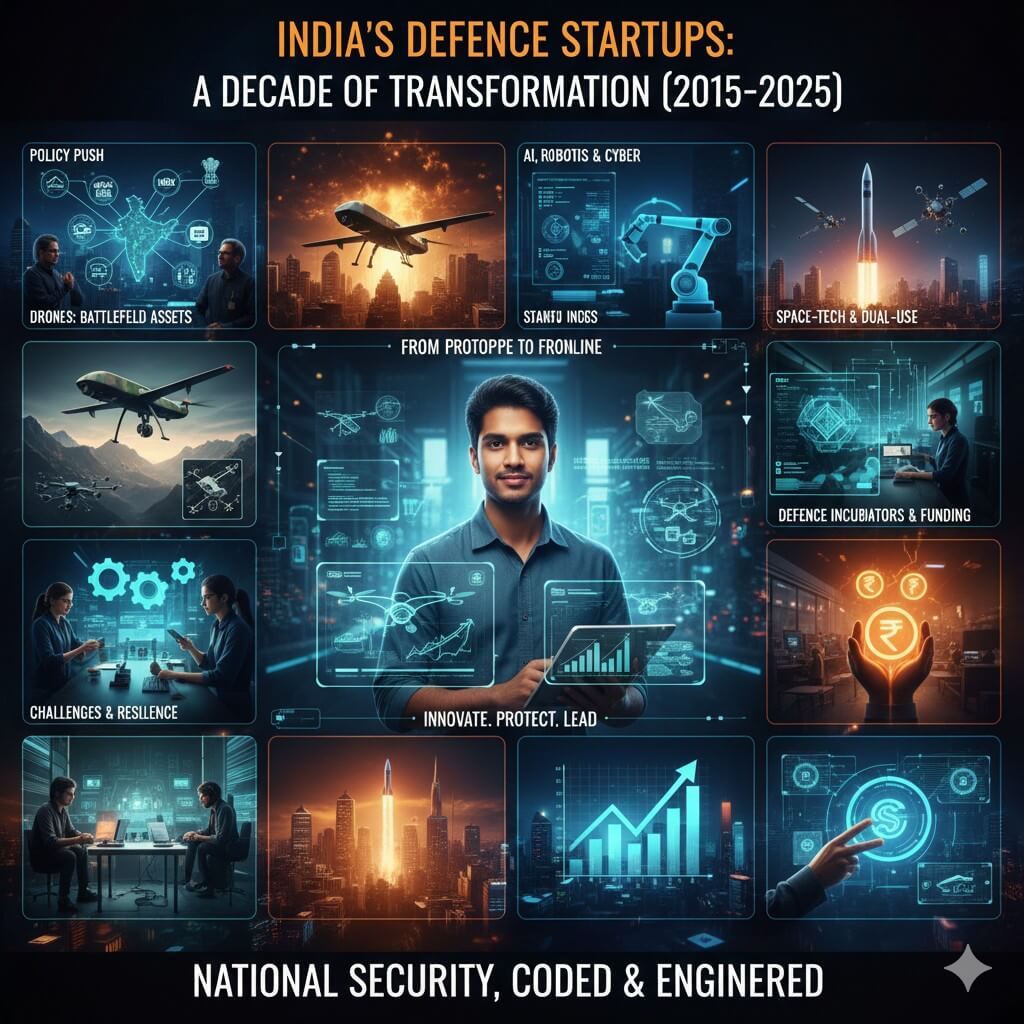
For decades, India’s defence sector was dominated by large public sector undertakings (PSUs) and government-led research organizations like DRDO. While they built critical systems, innovation often moved slowly, and private players—especially startups—had limited room to enter. That changed in the last decade. With policies like Make in India, Startup India, and defence-specific innovation missions, a wave of startups entered the scene, transforming India’s defence ecosystem. Today, these young companies are building drones, cybersecurity solutions, AI-driven surveillance, and even space-tech systems, many of which are being adopted by the armed forces.
Policy Push and Ecosystem Shift
The turning point came around 2015–2016, when the Indian government opened defence production to private companies under the Make in India campaign. The creation of the Defence Innovation Organisation (DIO) and the iDEX (Innovations for Defence Excellence) platform gave startups a structured way to pitch, test, and scale their solutions. Schemes like Technology Development Fund (TDF) also offered financial support for indigenous R&D. Together, these changes lowered entry barriers and encouraged risk-taking among young entrepreneurs.
Drones: From Hobby Kits to Battlefield Assets
The most visible success story is in drones. A decade ago, drones in India were mostly for photography or hobby use.
Today, startups are building combat-ready unmanned aerial vehicles (UAVs), swarm drones, and logistics drones for
defence forces.
ideaForge (founded by IIT-Bombay alumni) is now a leader in military drones, supplying high-end UAVs to the Indian Army
for surveillance and reconnaissance.
NewSpace Research & Technologies, a Bengaluru-based startup, is developing swarm drone systems capable of overwhelming
enemy defences—a critical futuristic technology.
Botlab Dynamics, which once started with light-show drones, has pivoted into tactical drones for border security.
This journey shows how startups evolved from experimental projects to frontline defence suppliers.
AI, Robotics, and Cybersecurity Startups
The past decade has also seen startups leverage artificial intelligence and robotics for defence applications. With
cyber threats rising, India needs homegrown solutions.
Tonbo Imaging, a Bengaluru-based firm, creates advanced imaging systems—night vision and thermal cameras—that are now
used by Indian and foreign defence forces.
CRON Systems began with smart perimeter security solutions for the Indian Army at the LOC (Line of Control).
Today,their AI-driven sensors and surveillance platforms protect some of the toughest borders in the world.
Sagar Defence Engineering builds autonomous boats and marine systems, ensuring India’s naval edge.
These startups moved from prototype demonstrations to real deployments, proving that Indian innovation could stand
alongside global defence technologies.
Space-Tech Startups and Defence Dual Use
India’s space-tech boom also overlaps with defence. Satellites, rocket systems, and communication tools built by
startups often have dual applications.
Pixxel, a space-tech startup by young IITians, is building a constellation of imaging satellites. While marketed for
climate and agriculture, such satellites also have strategic intelligence uses.
Agnikul Cosmos and Skyroot Aerospace, both private rocket companies, are reducing India’s dependency on foreign
launchers—a crucial advantage for defence in the long run.
The past decade blurred the line between space startups and defence startups, creating a dual-use technology pipeline.
Defence Incubators and Funding
Unlike traditional sectors, defence is capital-intensive and high-risk. To support startups, the government and armed
forces set up special incubators.
iDEX has supported over 300 startups through grants, mentoring, and trials.
Defence corridors in Uttar Pradesh and Tamil Nadu are nurturing local manufacturing ecosystems.
Corporate venture arms and global defence players are beginning to invest in Indian startups, seeing them as long-term
partners.
This ecosystem ensures that young entrepreneurs don’t just stop at ideas but scale into sustainable businesses.
Challenges Along the Way
Despite progress, the road hasn’t been easy. Defence procurement is still slow, with long testing and approval cycles. Startups also struggle with high R&D costs and limited early revenue. Global competition from established defence giants makes it harder to break through. Yet, the fact that several startups have survived—and thrived—over the past decade shows the resilience of India’s innovation story.
A Decade of Transformation
Ten years ago, the idea of defence startups in India seemed unrealistic. Today, they are an essential part of the national security conversation. From drones to AI, from imaging systems to autonomous vehicles, startups are no longer on the sidelines; they are shaping the battlefield of the future.
Conclusion
The past decade has been nothing short of a revolution in India’s defence sector. Startups that began with student projects or small prototypes are now supplying cutting-edge technologies to the armed forces. With the government’s continued support and a growing culture of innovation, India is on its way to becoming not just a major defence importer, but also an exporter. The story of defence startups shows us a larger truth: national security in the 21st century will not only be guarded by soldiers but also by coders, engineers, and entrepreneurs.